

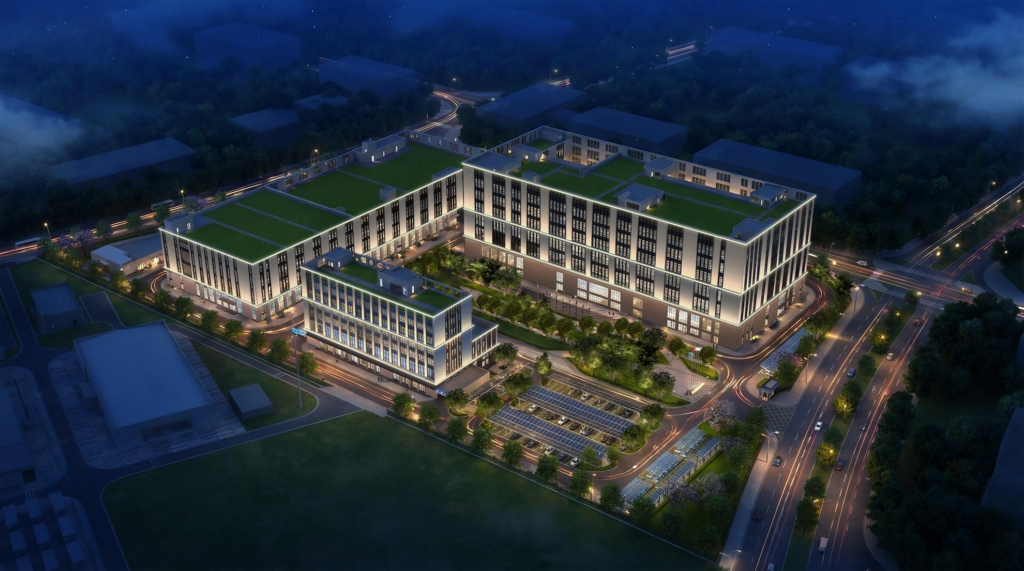
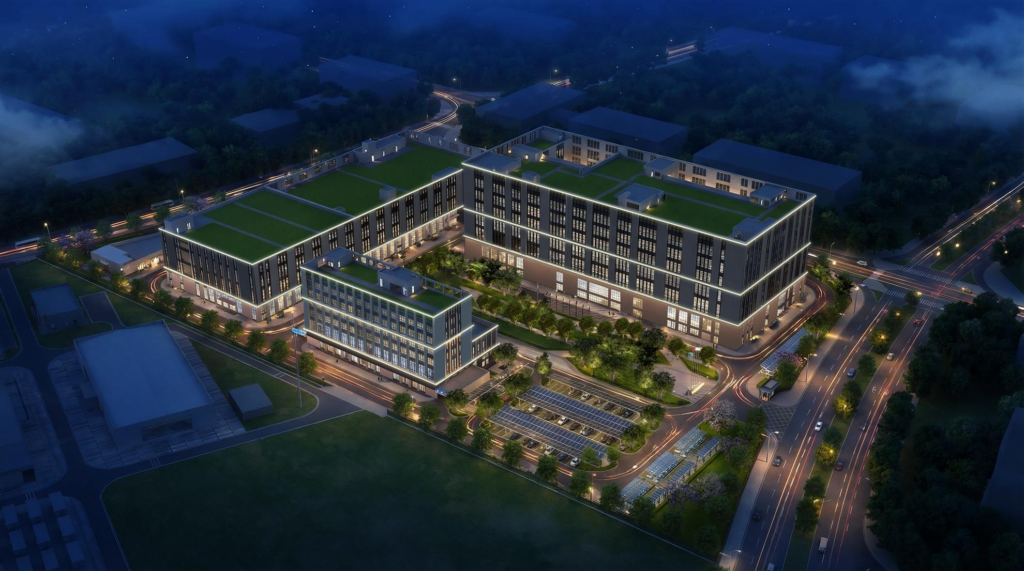
Set in the core of the Guangzhou Airport Economic Zone (Baiyun District), the base occupies a 52,000 m² site with a total floor area of 85,000 m², comprising two laboratory buildings, a laboratory support building and a warehouse. It is planned as an important research base for clean, low-carbon power technology. Its facade lighting will be carried out by Hongyu.
Design Concept: A Living Lattice of Clean Energy
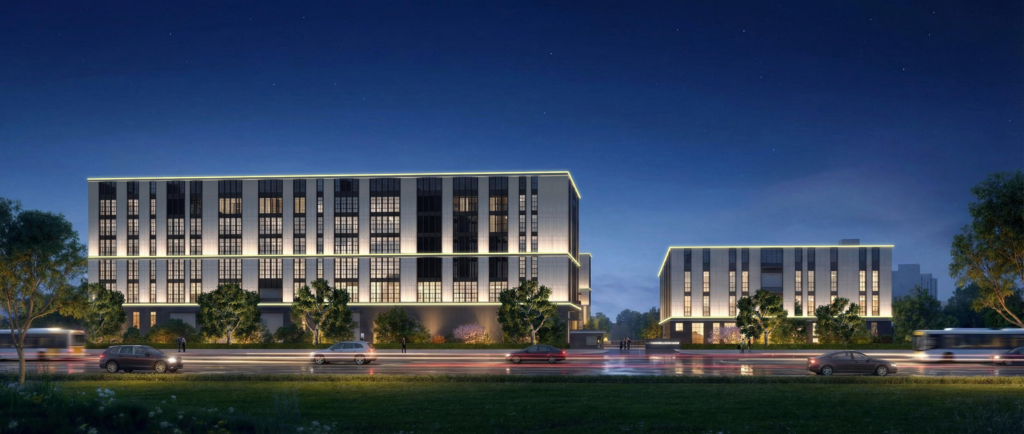
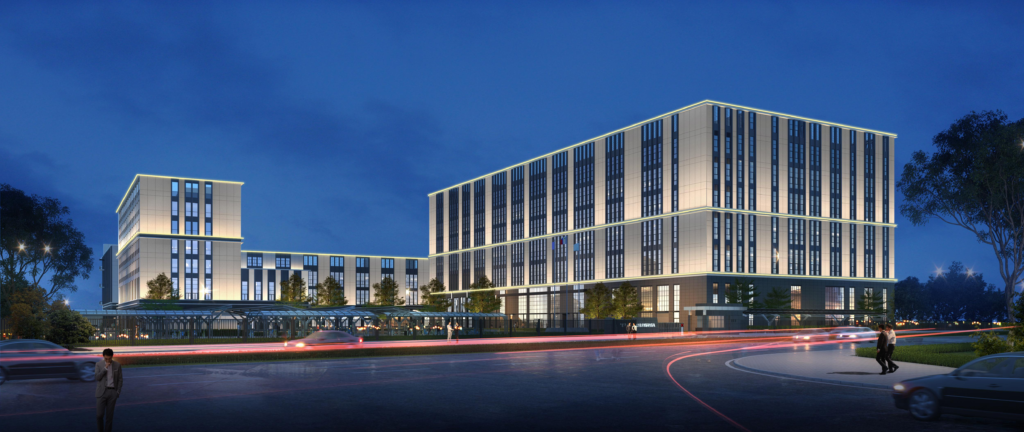
The architecture reads as a clean palette of interlaced horizontal and vertical lines. The lighting theme — “Rhythm of the Light Grid, Resonance of Crystal Energy” — turns this grid texture into a vast, intelligent crystal lattice: every illuminated cell is a unit of clean energy, and their brightness, color, and rhythm compose a quiet symphony of intelligence and low-carbon futures. In everyday scenes the campus glows in neutral 4000K white; on festivals the grid switches to full RGBW color, letting the facades pulse with slow, dynamic energy.
Effects: Light That Follows the Architecture
Linear LED light traces the roof parapets and floor-band edges, framing the dark window openings like a luminous grid, while interior light transmission adds depth behind the glass — a low-brightness, medium-contrast approach that keeps the complex bright, orderly, and recognizable from the city scale, yet comfortable at street level. A two-level luminance hierarchy directs Grade-1 brightness to the primary viewing facade and key intersections, reserving Grade-2 for secondary angles. Two operating modes cover the nightly 19:00–22:00 routine: full-on for peak hours, and an energy-saving mode that dims the surfaces and keeps only the crisp architectural outline.
Fixtures, Integrated and Invisible
Two linear systems carry the design: a 48 W RGBW LED wall washer (4000K) fitted with an L-shaped baffle color-matched to the exterior wall — shielding glare by day, concealing the fixture against the facade — and a 15 W RGBW LED linear light defining the building’s horizontal lines.
By tracing only the grid lines instead of washing the full facades, the research base reads at night exactly what it is by day: a precise, intelligent, low-carbon innovation campus — restrained in energy, rich in rhythm.